
14-10-2026
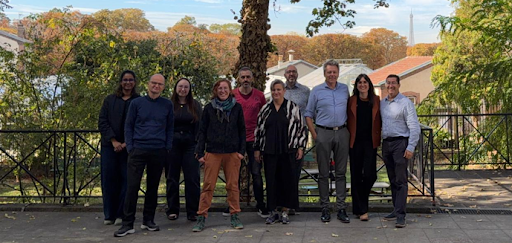
The DECUB consortium met in Paris on 5–6 October 2026 to review progress, present technical advances and coordinate the next steps in the project.
Hosted by Mines Paris – PSL, the plenary meeting brought together project partners to discuss the development of urban block archetypes, digital twins, environmental assessment methods and strategies for sharing project results with public authorities and industry.
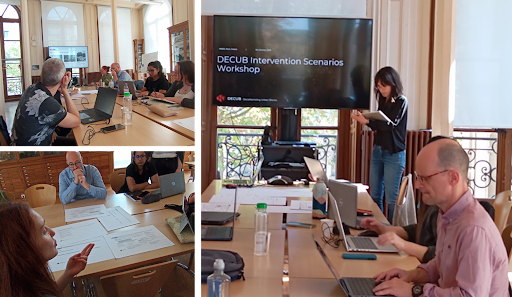
Urban Living Labs: identifying local values and co-creating interventions
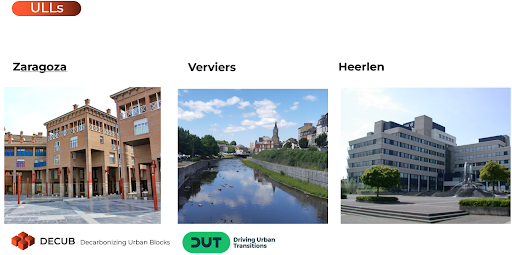
Work Package 2 (WP2) has made progress in establishing the foundations for participatory urban regeneration in the three DECUB Urban Living Labs: Zaragoza (Spain), Verviers (Belgium) and Heerlen (the Netherlands).
Concrete achievements include the selection of representative cases, stakeholder mapping, the collection of photographs and preliminary public data, and the implementation of three World Café participatory sessions.
These activities have helped identify the values associated with urban blocks and the building elements that local stakeholders consider priorities for transformation.
In Verviers, discussions addressed the Vesdre river, architectural heritage, and retail and commercial services. In Zaragoza, participants prioritised interventions involving the design and materials of the public square, façades, ground-floor uses, windows, heating and air conditioning, and accessibility. In Heerlen, priorities included road infrastructure, public spaces, glazing, façade elements and ground-floor accessibility.
The results demonstrate that urban regeneration involves more than improving energy performance. Interventions must also consider heritage, accessibility, public space and community needs. DECUB is therefore developing a participatory, gamified approach to help stakeholders explore the potential impacts of different interventions and balance the values that may be preserved, enhanced or lost.
The next steps include consolidating the urban analyses, developing circular intervention scenarios and establishing indicators and methodologies to assess their impacts on the tangible and intangible values identified by local communities.
Characterising urban blocks and assessing environmental performance
During the meeting, partners reviewed progress on Work Package 3 (WP3), which focuses on characterising urban block archetypes, analysing material flows and calculating environmental performance.
A key achievement has been the classification of urban blocks in the three Urban Living Labs (ULLs) — Heerlen in the Netherlands, Verviers in Belgium and Zaragoza in Spain. Using morphological and temporal indicators, the team has identified five archetypes per city and selected representative blocks for further analysis. The classification methodology is documented in deliverable D3.1 and provides a common basis for the project’s subsequent work.
Partners also discussed the selection of environmental indicators for Life Cycle Assessment (LCA), linking the proposed framework to the European Level(s) approach. The proposal distinguishes between a reduced set of indicators for communicating results and a more comprehensive set for research.
Work is also progressing on Material Flow Analysis (MFA), including building material inventories, material quantities and intensities, and the analysis of energy performance. These activities will help quantify existing material stocks and explore material inflows, reuse, recycling and disposal under urban regeneration scenarios.
The meeting further addressed absolute LCA at urban block level and the assessment of deep renovation strategies, connecting environmental impacts with resource use, human health and the transformation of existing buildings.
Advancing digital twins for urban analysis
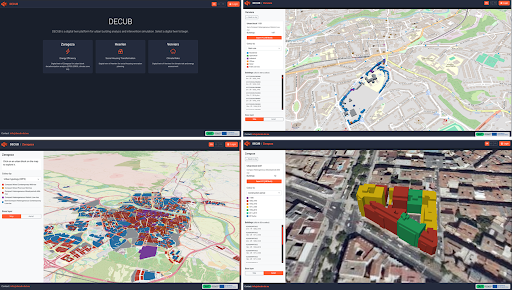
Work Package 4 (WP4) presented progress on the data infrastructure and reusable software components supporting DECUB’s digital twins.
The platform includes a 3D urban agglomeration view that represents urban blocks and uses the archetypes developed in WP3 as a map legend. This connects the urban classification work with the project’s digital visualisation tools.
Interoperability is another important development. The use of IFC files enables data exchange with other BIM/CAD applications and specialised environmental assessment tools, including Pleiades. This creates a basis for integrating digital twins with building energy simulation and LCA workflows.
Partners also discussed the challenges that remain, particularly the need to connect the digital twins more fully with results from other work packages. Further integration and testing will be essential to ensure that the models support the project’s increasingly detailed analyses.
Evaluating policies to support circular urban transformation
Work Package 5 (WP5), dedicated to Policy Evaluation and Implementation, presented its analysis of how circular economy policies are defined and implemented at European, national and regional levels, particularly in the construction and buildings sector.
The research combines text-mining techniques, thematic policy analysis and interviews with policymakers. It examines 38 policy documents from five countries: Belgium, the Netherlands, Germany, Spain and France.
The findings highlight several challenges. Circularity policies primarily emphasise energy, climate and economic objectives, while social and technological dimensions receive less attention. The analysis also identifies gaps in coordination between institutions, access to building data and the involvement of citizens and other relevant stakeholders.
The next steps will focus on developing an integrated evaluation framework combining digital twins, Life Cycle Assessment (LCA), Material Flow Analysis (MFA) and holistic value analysis. These tools will be applied to scenarios developed in the three Living Labs to assess their environmental and wider impacts.
The work will ultimately support the formulation of policy recommendations on integrating Circular Urban Economy (CUE) principles into the transformation and adaptation of urban blocks.
Strengthening collaboration and knowledge transfer
The plenary also addressed Work Package 6 (WP6), dedicated to dissemination, knowledge transfer and the development of a DECUB Business Network.
The project continues to expand its communication activities through its website, social media channels and video content, making its research and developments accessible to a wider audience.
A key priority is the establishment of the DECUB Business Network, which aims to build a community of companies, technology providers, software developers, public authorities and other organisations interested in applying the project’s results. The network seeks to encourage the adoption of DECUB technologies, promote open-source solutions and support their continued development beyond the project’s lifetime.
Partners also reviewed plans for a series of three policy briefs aimed at public administrations and industry and published in Dutch, English, French and Spanish to reach a broad European audience.
Coordinating the next steps
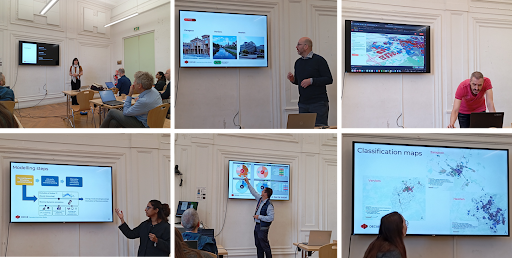
The second day of the meeting was dedicated to the follow-up committee, with presentations and discussions covering all six work packages. This provided an opportunity to review progress across the project, identify outstanding challenges and coordinate activities for the coming months.
The technical sessions highlighted the importance of integrating urban data, digital twins, environmental assessment and practical intervention scenarios. The continued collaboration between the partners and the three Living Labs will be essential to translating these developments into useful tools and approaches for urban regeneration.
The Paris meeting marked another step in DECUB’s ongoing work to support the decarbonisation of urban blocks through research, digital innovation and collaboration between cities, universities and technology partners.
About DECUB
DECUB (Decarbonizing Urban Blocks) is a European project funded under the Driving Urban Transitions (DUT) Partnership. Running from 2025 to 2027, it brings together partners from Spain, France, Belgium and the Netherlands to develop approaches and tools for urban block decarbonisation, tested through Urban Living Labs in Heerlen, Verviers and Zaragoza.