
Zaragoza is a city located in the autonomous community of Aragon in Northern Spain. The city centre has a population of approximately 691,037 people and covers an area of 973.8Km2. The city of Zaragoza has a rich cultural history, famous for its folklore, local cuisine, and landmarks.
Within the DECUB Project ULL of Zaragoza focuses on the city’s commitment to sustainable urban transformation, energy efficiency, and circular economy principles. Zaragoza is one of the European Net Zero Cities Mission participants, aiming for climate neutrality by 2030. It is also one of the five Spanish cities to receive the Mission Label, recognizing the quality and feasibility of its climate action plans.
Zaragoza Vivienda (ZVIV), the city’s municipal housing company, plays a key role in retrofitting Zaragoza’s most energy-inefficient building stock. Since 2019, it has managed over 29 million euros in residential retrofitting aid, benefiting 343 buildings and 6,488 private homes, generating a total investment of 64 million euros and creating approximately 110 sector-related jobs.
Although ZVIV has already promoted numerous interventions that can serve as valuable references for analysis and learning within the DECUB project, the key case study that will contribute to testing and validating the DECUB framework in multiple ways is the following:
Grupo San Bruno
It is a residential complex built in 1992, consisting of 150 dwellings designated for social rental housing, as well as 5 commercial units, several ground-floor offices, 134 parking spaces and 83 storage rooms, owned by Zaragoza Vivienda.
Grupo San Bruno is composed of several urban blocks. However, within the DECUB project, the intervention area will focus specifically on the urban block delimited by Paseo Echegaray y Caballero, Calle de Mundir I, Calle del Sepulcro and Calle Don Jaime I. This defined perimeter will constitute the operational scope for analysis, modelling and proposal development within the project framework.
The property is predominantly owned by Zaragoza Vivienda, whose main activity is the management of social rental housing, but other owners exist. The selected urban block includes the social housing units located within this defined area, together with several significant neighbouring buildings: Casa de la Iglesia (owned by the Archdiocese of Zaragoza), the Alma Mater Museum and the Diocesan Archive of Zaragoza. Therefore, the case study area combines social housing assets with institutional and cultural buildings, adding complexity and strategic relevance to the DECUB intervention scope.
The complex is located within a BIC (Asset of Cultural Interest) protection area due to its inclusion within the protection buffer zone of the Cathedral of La Seo. This condition may affect external interventions (facades, openings/windows, elements visible from the public space) and require validation and authorisation from the Heritage Commission, in addition to standard urban planning procedures. These restrictions must be incorporated from the outset.
With regard to installations and energy certification:
- DHW and heating: Individual systems per dwelling. The individualisation of thermal generation means that energy performance depends on the equipment installed in each dwelling and on occupants’ usage patterns. The minimum scope of energy characterisation required by the European project will need to be defined.
- Energy performance certificates: None available (no certificates exist, either global or per dwelling).
Clear architectural drawings and construction details corresponding to the as-built documentation are available and preserved by Zaragoza Vivienda. This information allows for a precise description of the building envelope (facades, roofs, junctions and openings) and reduces technical uncertainty for energy analysis and the definition of improvement solutions.
Prior to any analysis by DECUB, the main identified needs, existing problems and possible improvements are:
- Insufficient thermal insulation of facades, directly affecting energy demand and indoor comfort.
- External wooden window frames over 30 years old, with thermal and airtightness performance below current standards.
Additionally, it is proposed to analyse a further improvement aimed at increasing energy efficiency through the replacement of the current individual heating and DHW systems with more efficient alternatives. Both individual and collective options could be assessed depending on technical feasibility, maintenance, operation, costs and impact on users.
Any intervention on facades and windows must be designed in compliance with BIC protection criteria (urban image, composition, materials, finishes and administrative procedures).
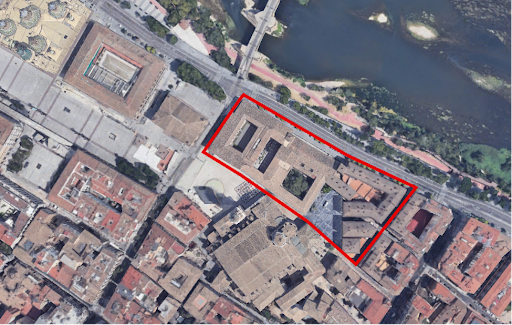
Source: Google Maps