
29-06-2026
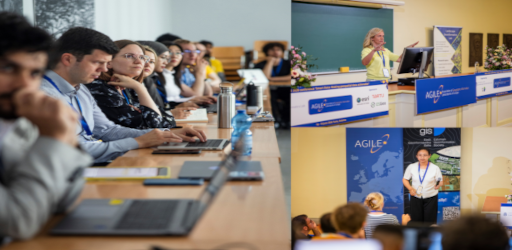
Research carried out within the DECUB project was presented at the AGILE Conference 2026, one of Europe’s leading scientific events in the field of Geographic Information Science, held in Tartu, Estonia, from 16 to 19 June. The conference brought together researchers and practitioners from across Europe to share the latest advances in geospatial technologies, spatial analysis and digital solutions for addressing urban and environmental challenges.
During the conference, Alejandro Domínguez-Lapeña presented the short paper “A comparison of generalised urban block 3D model variants considering attributes with an influence on urban analyses”, co-authored with Rubén Béjar and Ana Ruiz-Varona.
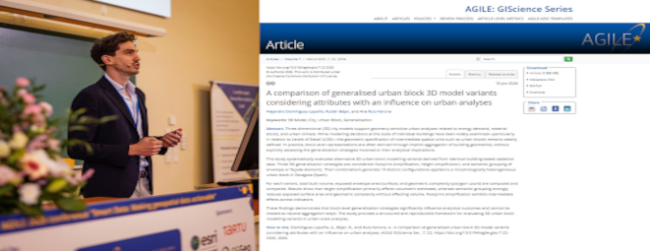
The study explores an often-overlooked question in the development of digital urban models: does the way we represent a city in 3D influence the conclusions we obtain from urban analyses? As cities increasingly rely on digital twins and spatial models to support planning and decision-making, ensuring that these models accurately represent reality becomes essential.
To answer this question, the researchers generated and compared 19 different 3D representations of the same heterogeneous urban block in Zaragoza using cadastral data. Each modelling approach simplified or represented buildings in a different way, allowing the team to analyse how these choices affect key indicators such as built volume, exposed building envelope and model complexity.
The results show that the level of detail and the generalisation strategy used to create a 3D model can have a significant impact on analyses related to energy performance, material stock estimation, urban climate studies and urban regeneration planning. In other words, the way a digital model is built is not merely a technical detail—it can influence the evidence used to support urban planning decisions.
These findings are closely aligned with the objectives of DECUB – Decarbonizing Urban Blocks, which focuses on the urban block as the fundamental unit for promoting circular and low-carbon urban transformation. Throughout the project, digital twins, material flow analysis and environmental assessment methods are being developed to help cities evaluate different regeneration scenarios and identify the most sustainable interventions.
Research such as this provides an important scientific foundation for DECUB by improving the reliability and robustness of the digital models used throughout the project. Better urban models lead to better analyses, enabling more informed decisions that support the transition towards climate-neutral, resource-efficient and resilient cities.
The presentation at AGILE 2026 also provided an opportunity to share DECUB’s research with the international Geographic Information Science community, strengthening collaboration and promoting the exchange of knowledge on digital tools for sustainable urban regeneration.